Omnichannel retailing: The complete guide for modern retailers


A customer discovers your brand on Instagram. She DMs you with a question, gets a reply, then visits your website and adds items to her cart, but doesn't check out. Three days later, she walks into your physical store and asks about the same products. Your staff has no idea who she is or what she was looking at.
That disconnect is exactly what omnichannel retailing is designed to solve.
Shopping habits have changed fundamentally. Today's customers move fluidly between social media, messaging apps, websites, and physical stores—often within the same purchase journey. Without a clear strategy connecting those touchpoints, businesses are left with dropped conversations, inconsistent experiences, and revenue walking out the door.
This guide covers what omnichannel retailing is, why it matters, how to build a strategy from the ground up, and which latest trends are reshaping retail.
What is omnichannel retailing?
Omnichannel retailing is the practice of integrating all your sales, marketing, and customer support channels (online and offline) so that every customer experiences one seamless, continuous journey, regardless of which touchpoint they use.
The key difference from multichannel retail comes down to connection. Multichannel simply means your brand is present in more than one place—on a website, an Instagram page, and in a physical store. Omnichannel means those places actively share data and speak to each other.
Why omnichannel retail matters more than ever
Many businesses have already adopted a multichannel approach—promoting products across various platforms and allowing customers to buy from whichever channel they prefer.
But updating real-time stock balances across multiple marketplaces is difficult. Managing consistent messaging across platforms is time-consuming. Analytics become confusing when each channel reports independently.
These inefficiencies compound into a brand reputation problem that's far harder to fix. Three challenges tend to cause the most damage:
Customer expectations have shifted: Today's shoppers research on social, ask questions on WhatsApp, purchase online, and sometimes return in-store. They expect a consistent experience and a brand that recognises them at every step.
Fragmented channels leak revenue: Missed messages, delayed replies, and inconsistent pricing or stock information across platforms translate directly into abandoned purchases and lost revenue.
Retention outperforms acquisition: Customer retention is 5 to 25 times more cost-effective than acquiring new customers. More than half of consumers repeatedly buy from brands they trust. Omnichannel retailing is what systematically builds that trust.

How to build an omnichannel retail strategy that works
A solid omnichannel retail strategy helps you engage customers, grow revenue, and build lasting loyalty. Here's how to approach it in five practical steps:
1. Map your customer journey across all touchpoints
Before integrating channels, identify where your customers actually are. Walk through the full purchase path:
Discovery (social media, search, ads)
Consideration (website, messaging apps, reviews)
Purchase (online store, in-store, chat)
Post-purchase (follow-up, returns, re-engagement)
This exercise reveals which channels deserve investment and where the biggest experience gaps currently exist.
2. Unify your customer data into a single profile
Fragmented data is the biggest obstacle to omnichannel success. A platform that consolidates chat history, purchase records, and customer preferences into one profile means your team always has context, whether the customer messages on Instagram today or WhatsApp tomorrow. This is the foundation of effective omnichannel retail integration.
3. Automate the repetitive touchpoints
Not every customer interaction needs a human response. Use automation to handle:
abandoned cart follow-ups
order confirmations
appointment reminders
re-engagement messages.
This keeps communication consistent at scale while freeing your team to focus on high-value conversations.
4. Personalize communications by channel and segment
68% of consumers prefer buying from brands that offer convenient, relevant communications. A WhatsApp broadcast to loyal customers should feel different from a re-engagement campaign to cold leads. Personalize the format, tone, and timing based on who you're reaching and where you're reaching them.
5. Measure, iterate, and optimize
Track response rates, conversion rates by channel, and customer satisfaction scores. Use analytics to identify which channels drive the most revenue and refine your approach accordingly. Data replaces guesswork and makes it easier to justify where to invest next.
Real-world examples of omnichannel retailing
1. Starbucks: Loyalty, mobile, and in-store, seamlessly connected


Source: Starbucks
Starbucks exemplifies omnichannel retail by integrating its mobile app with in-store interactions across multiple touchpoints. Customers can order ahead on the app, earn rewards whether they pay with a physical or digital Starbucks card, and receive personalized offers based on purchase history. Social media and email campaigns run in parallel — all channels reinforcing each other, not competing.
2. Timberland: Enhances in-store shopping with NFC technology


Source: Timberland
Timberland uses near-field communication (NFC) technology to create a seamless and engaging in-store experience. Shoppers can use store-provided tablets to tap on products and instantly access detailed information without needing to find a store clerk.
This approach gives customers independence while still offering support when needed.
Personalization software also provides tailored product recommendations, creating a unique and interactive shopping journey that learns each shopper's preferences.
By highlighting overlooked products and personalizing the experience, Timberland ensures customers feel informed and valued during their visit.
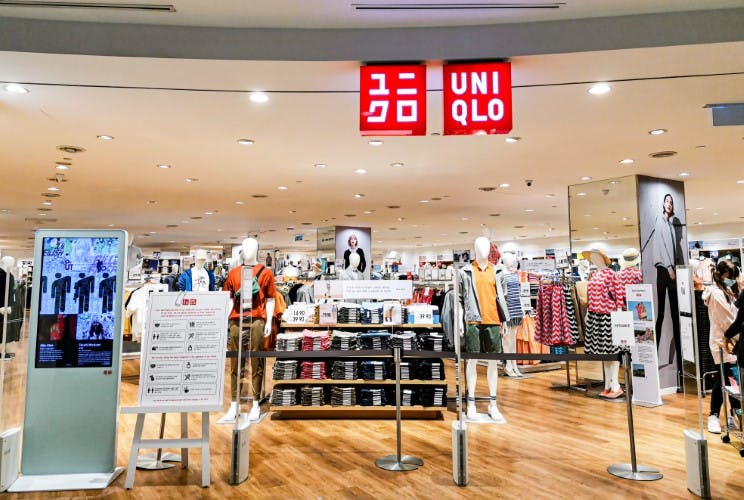
3. Uniqlo: Bridging digital and physical with O2O strategy

Source: Uniqlo
Uniqlo uses an online-to-offline (O2O) strategy to connect its e-shop, mobile app, and retail stores into a single customer experience. By syncing in-store interactions with digital tools, Uniqlo drives membership growth while gaining complete visibility of customer behaviour at every touchpoint. Data flows in from all directions, feeding personalisation and continuous improvement.
Uniqlo is very successful in running its O2O strategies. It uses online and offline marketing to complement each other. It is ingenious in taking advantage of getting access to data through their touchpoints. We strongly advise retailers to learn from Uniqlo and get started to adapt similar omnichannel marketing strategies. - Karena Tseung, APSIS Professional Services Consultant
4. SleekFlow case study: ZENXIN Organic


Source: ZENXIN Organic
ZENXIN Organic is a fast-growing organic food brand managing a large daily customer base across multiple messaging and social channels. As their customer base scaled, so did the complexity of coordinating teams and maintaining service consistency across platforms.
By implementing SleekFlow's omnichannel platform, ZENXIN consolidated all channel conversations into a single shared inbox, reduced response times, and eliminated the operational chaos of managing multiple apps simultaneously, without proportionally scaling its team.
Read the full case study: https://sleekflow.io/customer-stories/zenxin-use-case
How SleekFlow powers your omnichannel retail strategy
Having seen firsthand the challenges retailers, e-commerce brands, and O2O businesses face, SleekFlow built an all-in-one omnichannel conversational AI platform designed to address these challenges directly.
One inbox for every channel your customers use
High-volume retail businesses handle a constant stream of customer conversations across social media and messaging apps. On SleekFlow, your entire team logs into the same shared inbox across WhatsApp, Facebook, Instagram, Telegram, WeChat, SMS, and more, handling conversations collaboratively without signing in and out of separate platforms.
From the customer's perspective, they're simply messaging from their preferred app. From your team's perspective, everything is in one place, complete with conversation history, customer details, and order context. It's a win for both sides.


AI agents that handle customer queries around the clock
Retail customers don't wait for business hours. SleekFlow's AI agents respond instantly to frequently asked questions, check order statuses, qualify leads, and route complex queries to the right team member, with full conversation context already loaded. Customers get fast answers; your team handles the conversations that actually need a human touch.


Automated workflows that turn browsers into buyers
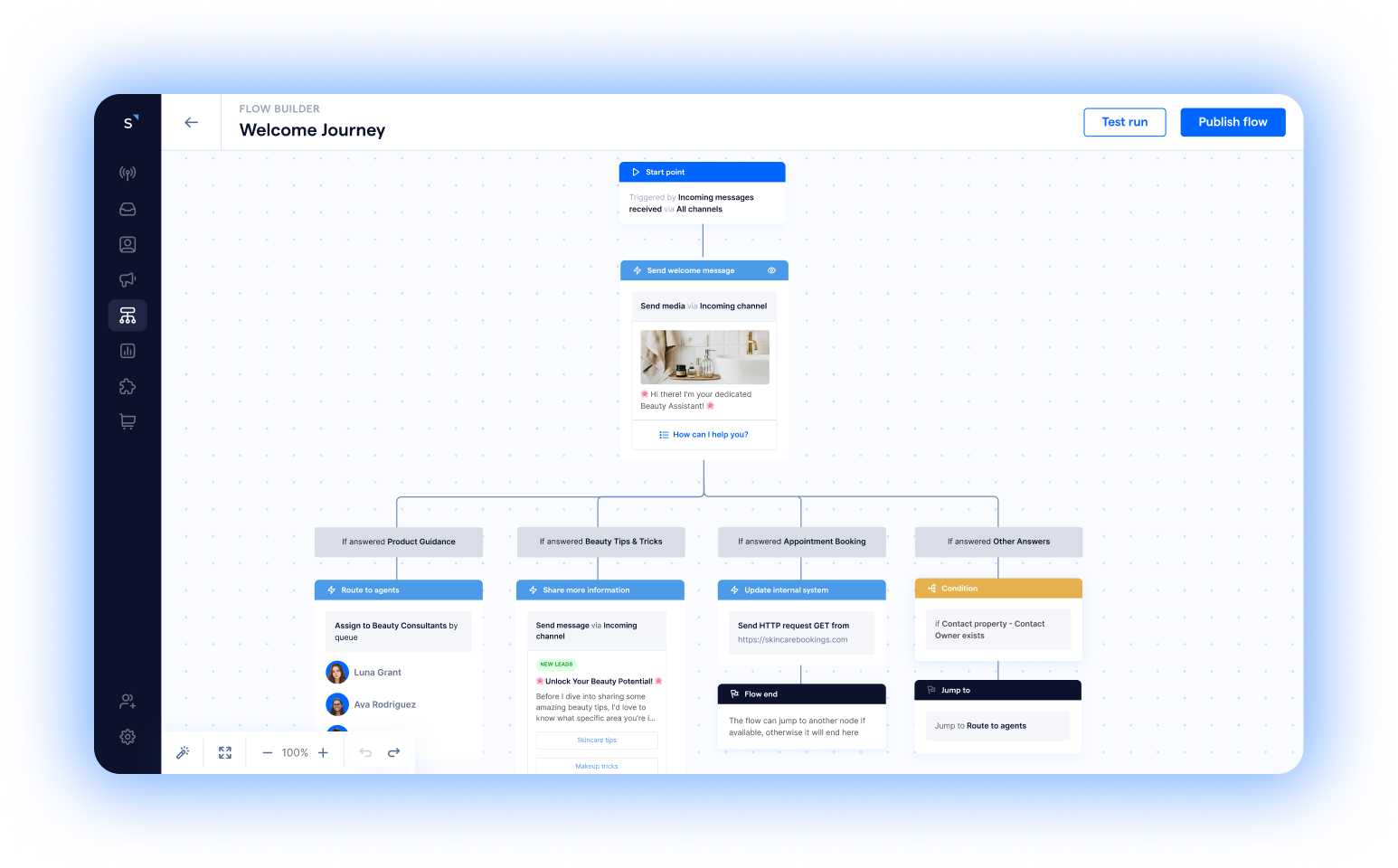
Impulse buying accounts for 40% to 80% of all purchases. The shorter and smoother the path from interest to checkout, the more customers convert. SleekFlow's Flow Builder automates abandoned cart reminders with personalized offers, post-purchase follow-up sequences, and re-engagement campaigns, all triggered automatically based on customer behaviour rather than manual effort.
With WhatsApp messages carrying a 98% open rate compared to just 22% for email, automating these touchpoints through messaging channels maximises every opportunity to recover lost revenue.

Shopify & CRM integration for seamless order management
When a customer asks about their order, your team shouldn't need to switch between five different tabs to find the answer. SleekFlow's native Shopify integration surfaces order details directly alongside the chat, so any team member can respond accurately and immediately, regardless of who handled the last conversation.
Product catalogues and payment links are also accessible directly within the chat, so customers can go from browsing to purchasing in just a few taps.
For a deeper customer context, SleekFlow integrates with Salesforce and HubSpot CRM. No matter which channel a customer reaches out from, all the information your team needs is available on the same screen within seconds.


Analytics that show you what's actually working
Precise analytics are essential for understanding customer behaviour and making confident decisions about where to invest. SleekFlow's analytics dashboard tracks response times, conversation volumes, broadcast campaign performance, and conversion rates by channel, giving you a clear view of what's driving revenue and what isn't.
Rather than relying on instinct, you can identify the highest-performing channels, optimize your team's workflows, and build on what's working with confidence.


Start building your omnichannel retail strategy today
Omnichannel retailing is no longer a strategy reserved for large retailers with enterprise budgets. The tools exist today to deliver connected, personalized customer experiences at any scale, and the businesses that act on this now are building the customer loyalty that compounds over time.
Whether you're running a growing e-commerce brand, managing a hybrid online-offline retail operation, or looking to bring order to a team spread across too many messaging apps, the fundamentals are the same. Understand your customer journey, unify your data, automate the repetitive, and personalize the rest.
SleekFlow is built to make that possible.

Want to outcompete your peers with SleekFlow's help?
Book your personalised demo with SleekFlow today and unlock the potential of seamless communication
{{__phrase_faq-title__}}
{{__phrase_share-article__}}