How to create a WhatsApp chatbot for business in the UAE


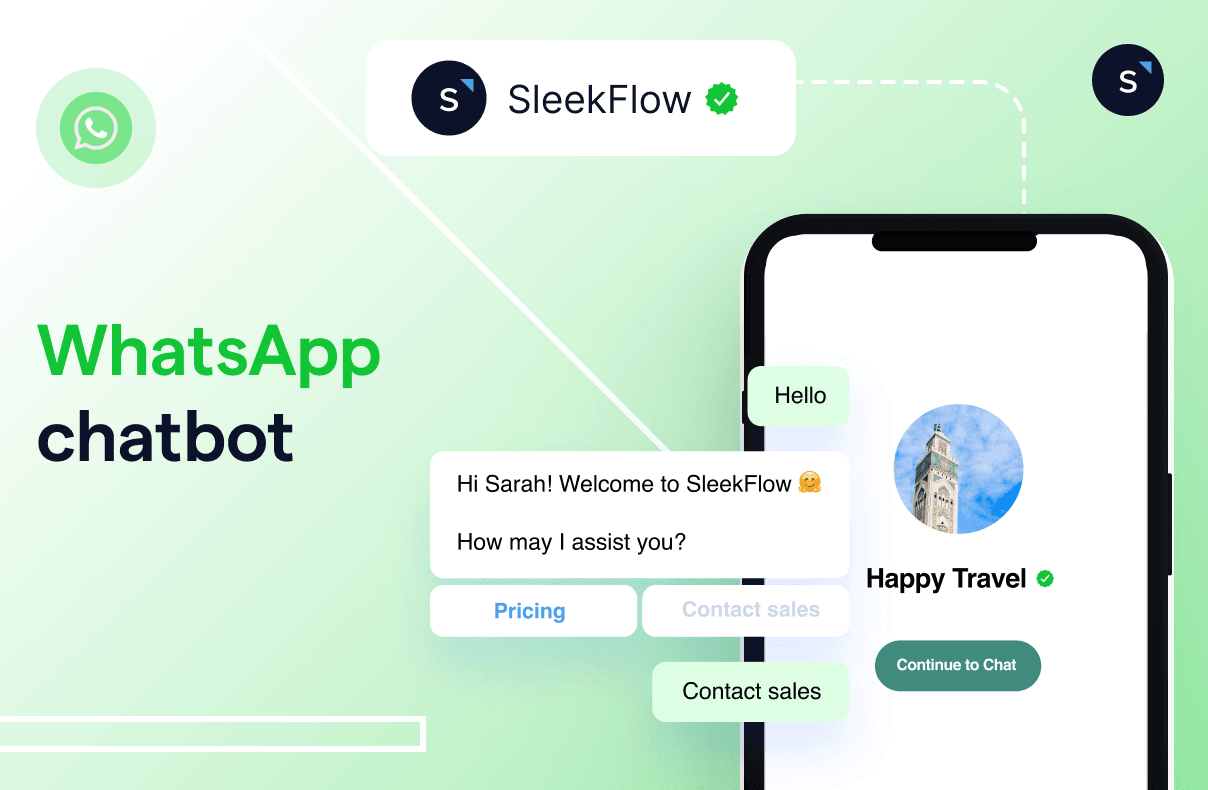
A WhatsApp chatbot helps businesses in the UAE answer common questions faster, qualify leads, handle after-hours enquiries, and route customers to the right team without making people wait for a reply. That matters in a market where internet penetration in the UAE stood at 99.0% at the end of 2025, 67% of consumers used their phones as part of their latest retail purchase, and 85% of UAE residents want businesses to offer customer support through WhatsApp.
At the same time, a WhatsApp chatbot should not replace human support altogether. A Zbooni survey found that 87% of UAE consumers prefer a real person over a chatbot or AI for customer service, which is why the best chatbot setups are designed to handle repetitive queries, lead qualification, routing, and basic updates, while escalating sensitive or complex conversations to a human agent. This also aligns with WhatsApp’s Business Messaging Policy, which says businesses may use automation during the 24-hour window only if they provide prompt, clear, and direct escalation paths.
In this guide, we’ll explore how to create a WhatsApp chatbot for business in the UAE, what use cases it works best for, and how to combine automation with human support to improve customer service, marketing, and sales performance.
What is a WhatsApp chatbot


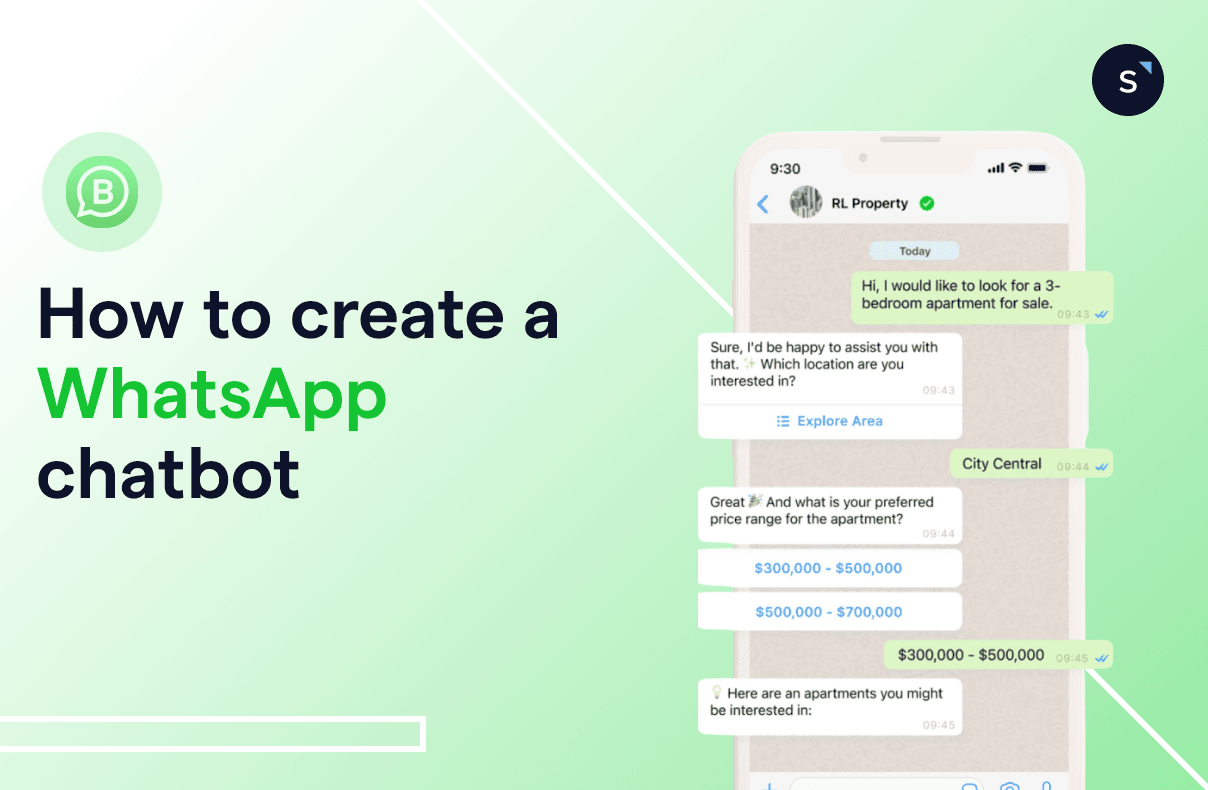
A WhatsApp chatbot is an automated conversation experience built on the WhatsApp Business Platform. Businesses use it to answer common questions, qualify leads, send updates, and guide customers through sales or support tasks inside WhatsApp. The platform supports automated messages, customer support chatbots, interactive messages, rich media, and scalable business messaging.
Not all WhatsApp chatbots work in the same way. In practice, businesses usually use three different formats, depending on the type of conversation they want to automate.
Rule-based chatbots are best for structured, predictable tasks such as FAQs, routing, lead intake, and order-status queries. They follow predefined decision trees, so they work well when the business already knows the likely customer questions and the correct next step.
AI chatbots or AI agents are better for more open-ended conversations. They can understand intent, handle broader customer questions, qualify leads, recommend products, and support appointment or sales workflows with more flexibility than scripted bots.
WhatsApp Flows are ideal for structured task completion inside the chat itself. They let businesses create interactive, multi-screen journeys for actions such as booking appointments, requesting quotations, signing up for promotions, or completing registrations without sending users to an external form.
Key features of WhatsApp chatbots include:
Automated Conversations: Engage customers, answer common questions, and assist users in tasks like choosing products or scheduling appointments—without human intervention.
Instant Responses: Provide immediate answers, significantly enhancing customer satisfaction through real-time communication.
Customizable Flows: Set tailored workflows to address specific scenarios, such as handling inquiries, customer support requests, or sales interactions.
CRM Integration: Integrate seamlessly with Customer Relationship Management (CRM) systems to track interactions, personalize responses, and enhance customer experiences.
Multilingual Support: Leverage AI to communicate with customers in multiple languages, effectively expanding your reach to a global audience.
To learn more, explore our guide on the WhatsApp Business API, or discover how your business can leverage WhatsApp for e-commerce.
Why should your business in the UAE use a WhatsApp chatbot?
1. Improved customer experience
A WhatsApp Business chatbot significantly enhances your customer service by automating routine and repetitive tasks. This allows your business to deliver quick, efficient responses that improve customer satisfaction. In the UAE, 89% of consumers say quick response times are one of the most important factors in a positive customer service experience, highlighting how critical instant communication has become. Businesses that use automated channels like WhatsApp chatbots can meet these expectations by providing immediate replies and faster support.
From product recommendations to order processing and appointment bookings, a WhatsApp chatbot streamlines these interactions, providing customers with a seamless, hassle-free experience.
2. Increased customer engagement
A WhatsApp chatbot can provide instant replies to customers 24/7, ensuring that inquiries are addressed promptly. This is especially important in the UAE, where customers expect quick responses.
Also, chatbots can use customer data to personalize messages, offering tailored experiences that boost customer satisfaction and retention.
3. Building a strong brand identity
Chatbots can consistently uphold a brand’s personality across every interaction. By incorporating distinct messaging, tone, and visual identity into chatbot conversations, businesses can reinforce their brand image and create memorable customer experiences. This consistency helps strengthen brand recognition and loyalty over time. In the UAE, 87% of consumers say they trust the brands they use, making trust one of the most important drivers of purchase decisions. Maintaining a clear and consistent brand identity across customer touchpoints, such as messaging apps like WhatsApp, can therefore play a critical role in building long-term customer relationships.
4. Enhancing marketing campaigns
Businesses today are heavily invested in lead generation. However, attracting prospective audiences to follow you on social media and subscribe to your email list can be quite challenging. It's crucial for businesses to optimize every customer touchpoint within the conversion funnel.
For instance, during a "click to WhatsApp" campaign, you should never leave customers waiting. Response time is crucial. Research shows that the optimal lead response time is 5 minutes or less, meaning prompt replies significantly increase conversion chances. Yet, responding instantly can be overwhelming for a single team member and costly if relying solely on live chat agents.
A WhatsApp chatbot resolves this issue by instantly greeting and assisting prospects, providing immediate answers, and ultimately boosting your campaign’s conversion rate.
5. Boosted sales and conversions
With a WhatsApp chatbot, your business can stay available round-the-clock, even outside of regular business hours. This is crucial for capturing leads and sales from customers who prefer to engage at their convenience.
Chatbots can qualify leads by asking a series of pre-determined questions, helping businesses to segment prospects and follow up more efficiently.
6. Integration with existing systems
WhatsApp chatbots can integrate seamlessly with CRM systems like Salesforce, allowing businesses to track customer interactions and provide more targeted services.
For businesses in retail or e-commerce, chatbots can be connected to your e-commerce platform to help customers with product inquiries, order tracking, and even completing purchases directly within WhatsApp.
Learn more about the best practices when creating a WhatsApp Chatbot.
Build a WhatsApp chatbot with no code
Creating a WhatsApp chatbot no longer starts with a slow, one-size-fits-all application process. Today, businesses in the UAE can get started in three practical ways: build directly on Meta’s Cloud API, onboard through a WhatsApp Solution Partner / BSP, like Sleekflow, or use WhatsApp Coexistence to connect an existing WhatsApp Business App number to platform-based tools on the same number. For teams that want to experiment before connecting a real account, SleekFlow also offers a test number so you can build AI agents and automations first.
Before you build
Before setting up the chatbot, define what you actually need it to do. Start by choosing whether your chatbot will be rule-based, AI-led, or built around WhatsApp Flows for structured tasks such as booking, lead capture, or quote requests. Then map your top customer intents, decide when the bot should hand over to a human, and identify which systems need to be connected, such as your CRM, e-commerce platform, or booking tool. For UAE businesses, it is also worth deciding early whether you need both the WhatsApp Business App and API together through Coexistence, especially if your team already uses the app today.

Step 1: Choose your setup path
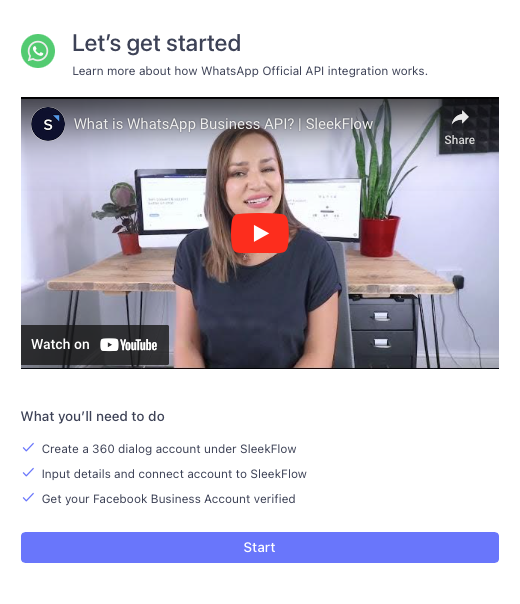
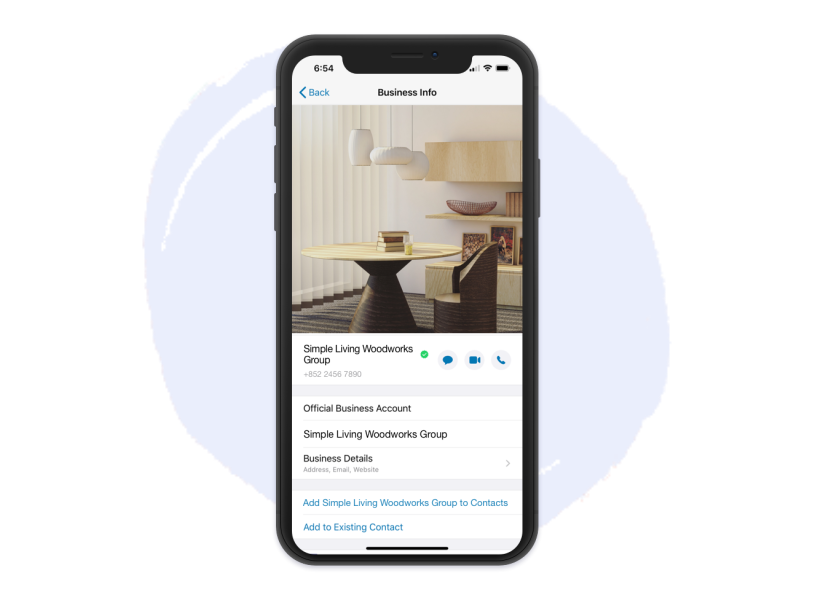
If your business has in-house technical resources, you can build directly with Meta’s Cloud API. If you want faster onboarding, shared inboxes, automation, analytics, and implementation support, working through a Solution Partner / BSP is often the more practical route. If you already use the WhatsApp Business App and want to keep that experience while adding automation and integrations, Coexistence is the better upgrade path.
Step 2: Design the conversation experience
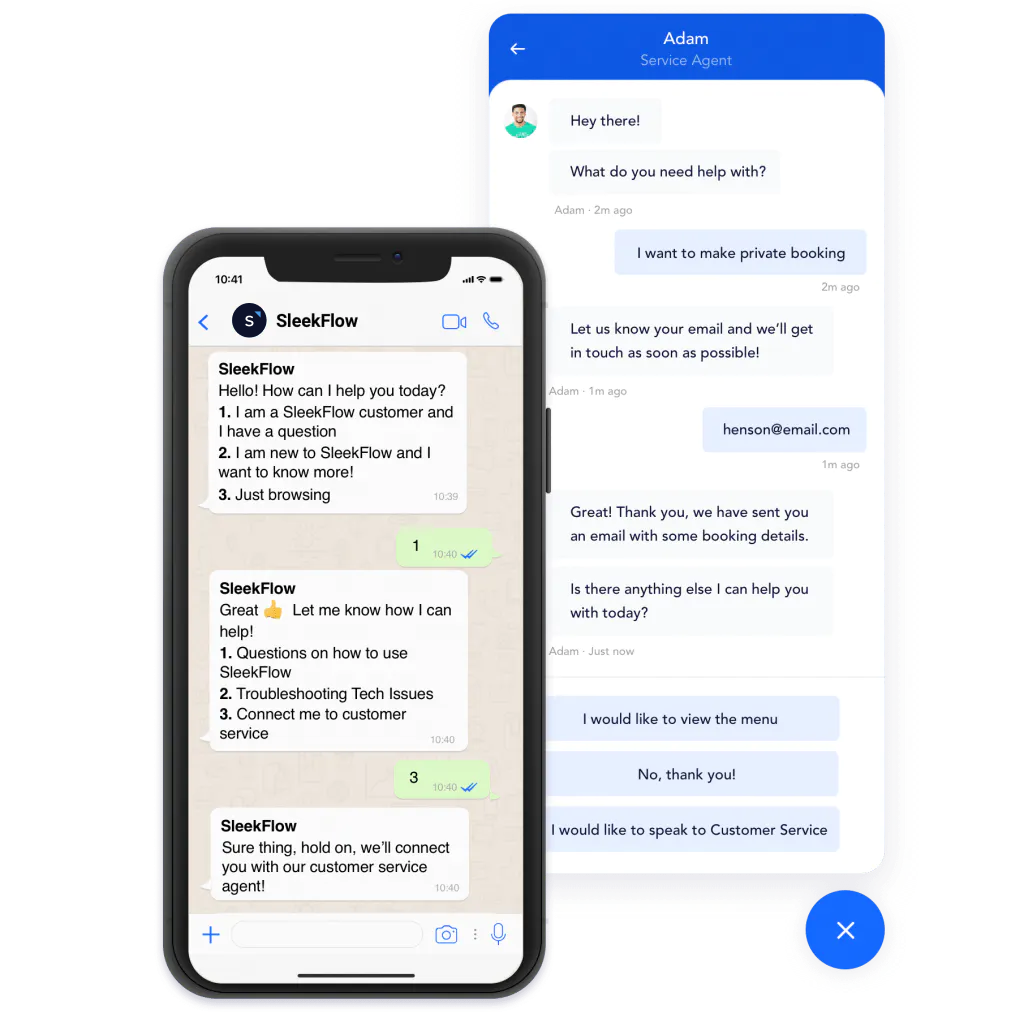
The strongest WhatsApp chatbots are not built around long text-only scripts. They are built around real customer tasks. Use quick reply buttons, list messages, and WhatsApp Flows to help customers move through common journeys such as product discovery, appointment booking, lead qualification, or order support with fewer drop-offs. At this stage, you should also define clear human handoff rules for complex, sensitive, or high-value conversations. WhatsApp’s Business Messaging Policy allows automation during the 24-hour customer service window, but it also requires businesses to provide prompt, clear, and direct escalation paths to human support.
Get samples of message replies from our templates for WhatsApp chatbot auto-replies. auto-replies.

Step 3: Build the chatbot in a no-code platform

Creating a WhatsApp chatbot from scratch can be quite challenging for inexperienced users in the UAE. To avoid unnecessary complications, we highly recommend using a bot builder.
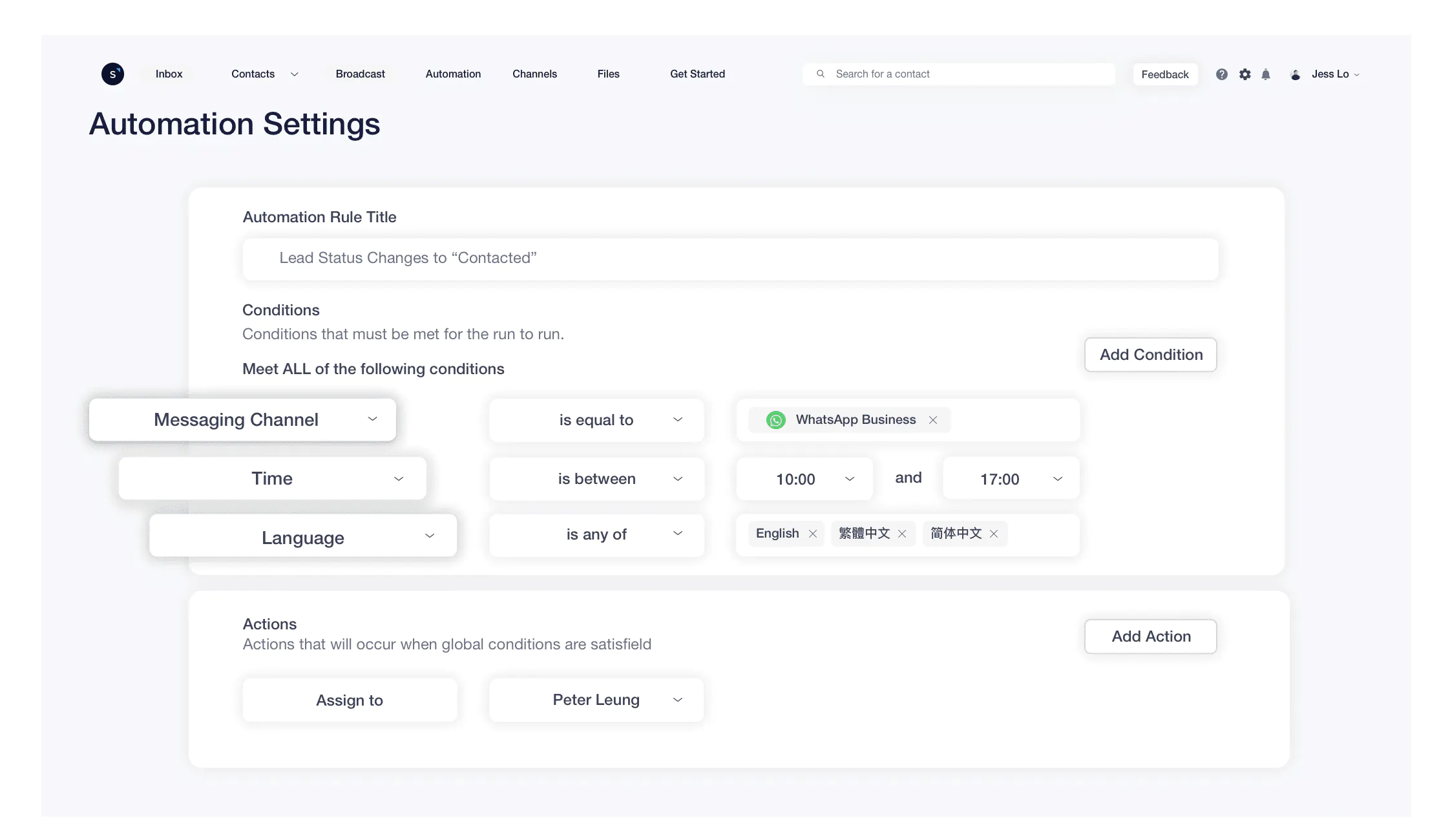
Once the logic is clear, use a no-code builder to turn it into a working chatbot. SleekFlow’s Flow Builder lets teams create automated journeys, trigger messages based on customer behavior, and manage data workflows and team collaboration across channels without writing code. This is where you can combine AI replies, routing rules, CRM-backed personalization, and structured customer journeys in one place. The goal is not to remove people from the process entirely, but to reduce manual handling of repetitive conversations while routing complex cases to human agents.
Although automation is the ultimate goal, SleekFlow is designed to qualify leads and centralize information for a seamless AI + human handoff experience. Bots are best suited for handling repetitive, high-volume, and predictable questions, allowing businesses to respond instantly and efficiently. Meanwhile, human agents focus on escalations, complex or nuanced issues, emotionally sensitive conversations, and high-value sales interactions where empathy and judgment are essential. If you're interested in AI integration, you can upload your knowledge base and get AI-generated responses tailored to your brand's needs.
Learn how you can upload your knowledge base and get AI-generated responses tailored to your brand.

See SleekFlow AI in action
Discover how you can adopt Agentic AI for your business messaging with just a small amount of data and setup time.
Step 4: Test, launch, and optimize

Before launching, test the chatbot end to end: button paths, AI answers, human handoff, CRM sync, template use, and post-chat follow-up. If you plan to use the chatbot for promotional outreach in the UAE, make sure you have explicit consent, store that consent properly, and provide a clear unsubscribe path. TDRA says marketing messages require prior explicit consent, may only be sent between 7 AM and 9 PM UAE time, and must allow customers to opt out. UAE PDPL also requires consent to be clear, simple, unambiguous, and provable. After launch, track the metric that matters most to your business, whether that is faster first response, more qualified leads, more bookings, or better order recovery.
See how Anigma Technologies uses WhatsApp Chatbot to recover canceled orders, providing an excellent model for businesses in the UAE.
SleekFlow enables us to get customer feedback fast, which is important for us to learn and iterate our services from serving each customer.


Wael Ali
Marketing Manager, Anigma Technologies
WhatsApp chatbot examples for UAE businesses
The strongest WhatsApp chatbot experiences are not built around long text-only replies. They use quick reply buttons, list messages, product messages, and WhatsApp Flows to help customers complete tasks faster inside the chat, while giving teams a clear path to step in when a conversation becomes more complex.
1. Retail and e-commerce
Trigger: A shopper clicks a product ad, visits your website, or messages your business asking about availability, sizing, or delivery.
First reply: “Hi [customer name], I can help you find the right product, check stock, or answer delivery questions. What would you like to do?”
Quick-reply buttons:
Browse products
Check availability
Delivery information
Human handoff: Route to a sales agent if the customer asks about bulk orders, special discounts, or detailed product advice.
Follow-up path: If the customer leaves without buying, send a compliant reminder or product follow-up through an approved template.
This type of flow works well because WhatsApp supports interactive formats such as quick reply buttons, list messages, and product-rich journeys, while SleekFlow adds CRM-backed personalization and follow-up automation. In SleekFlow’s published Anigma example, automated re-engagement helped recover 70% of canceled orders and 13% of abandoned carts.
2. Real estate
Trigger: A prospect asks about a listing from a Click-to-WhatsApp ad or a property page.
First reply: “Hello [customer name], I can help you with pricing, location details, and viewing arrangements for [property name]. What would you like next?”
Quick-reply buttons:
Request brochure
Book a viewing
See similar listings
Human handoff: Escalate to an agent when the lead is qualified, requests negotiation, or asks detailed financing or legal questions.
Follow-up path: Send viewing confirmations, reminders, and post-viewing follow-up using approved templates where required.
This is a strong UAE use case because real estate journeys are often high-intent and time-sensitive, and structured WhatsApp flows can qualify leads before a human agent steps in. WhatsApp Flows are designed for interactive tasks such as registrations, requests, and multi-step forms inside the chat.
3. Clinics and healthcare
Trigger: A patient asks about booking, clinic timings, or a treatment category.
First reply: “Hi [customer name], I can help with appointments, clinic information, and treatment-related questions. What would you like help with today?”
Quick-reply buttons:
Book appointment
Clinic hours
Treatment information
Human handoff: Escalate to a staff member for complex treatment discussions, billing issues, or sensitive personal questions.
Follow-up path: Use the chatbot for confirmations, reminders, and routing, then pass non-routine cases to human staff.
For healthcare-related use cases, keep the chatbot focused on booking, reminders, routing, and non-sensitive enquiries. WhatsApp’s policy says businesses should not use WhatsApp for telemedicine or health-related information where regulations prohibit using systems that do not meet heightened requirements.
4. F&B
Trigger: A customer asks about reservations, menu items, delivery, or a promotion.
First reply: “Welcome [customer name], I can help with reservations, menu questions, and delivery updates. What would you like to do?”
Quick-reply buttons:
Book a table
View menu
Track my order
Human handoff: Escalate to a team member for large group bookings, complaints, or special event enquiries.
Follow-up path: Send reservation confirmations, delivery updates, or post-visit re-engagement messages if the customer has opted in.
This kind of flow works especially well on WhatsApp because the channel supports fast, mobile-first interactions and structured actions without forcing customers to switch apps or fill out long forms. WhatsApp Business Platform features are built for automated messages, customer service engagement, and scalable business messaging.
5. Sports, leisure, and hospitality
Trigger: A customer wants to book a class, court, room, or experience.
First reply: “Hi [customer name], I can help you check availability, make a booking, or answer questions about our services. What would you like to do next?”
Quick-reply buttons:
Check availability
Book now
Ask a question
Human handoff: Transfer to a staff member when the customer needs a custom booking, event support, or urgent assistance.
Follow-up path: Send reminders, updates, and post-booking support automatically, while keeping the team available for exceptions.
This is already proven in the UAE. In SleekFlow’s JustPadel customer story, chatbot automation and workflow automation helped reduce average response time by 70%, while centralizing bookings and customer communication into one platform.
What these examples show
For UAE businesses, the best WhatsApp chatbot journeys are not generic auto-replies. They are structured around real customer tasks, combine interactive buttons or Flows with CRM-backed context, and always include a clear human handoff path for higher-stakes conversations. That is the setup most likely to improve response speed, lead quality, and customer experience without making the chatbot feel like a dead end.
Go beyond: Start using the WhatsApp AI chatbot from SleekFlow!
In today’s fast-paced world, businesses need to evolve quickly to meet customer expectations. Chatbots powered by AI are no longer just a luxury—they’re essential for delivering responsive, efficient, and personalized customer experiences. SleekFlow’s WhatsApp AI chatbot goes beyond simple automation to transform the way businesses engage with customers.
With SleekFlow’s AI chatbot, you can integrate seamless conversational flows, leverage AI to understand and respond to customer queries, and even automate booking, support, and order management.
The real game-changer? You get to keep the personal touch, even while automating repetitive tasks. Your team can focus on more strategic activities, while the chatbot handles routine inquiries 24/7.
Ready to elevate your customer experience? SleekFlow makes it easy to implement this powerful solution with just a few simple steps. Start today, and watch your customer interactions reach a new level of efficiency, all while maintaining a human touch.
Discover the ideal AI chatbot solution for your UAE business today and enhance your customer engagement and operational efficiency.
Sleekflow Use Cases:


1. Nafsi Health, a UAE mental health platform, doubles conversions with WhatsApp engagement
WhatsApp first patient engagement with SleekFlow
Nafsi Health, the UAE’s first fully DHA‑licensed online psychiatry and psychotherapy platform, needed to build trust and handle many sensitive patient inquiries. Instead of relying solely on its app, Nafsi shifted to WhatsApp, the preferred channel in the region, using SleekFlow’s automation and central inbox to communicate more naturally with users.
Working with SleekFlow’s team, Nafsi implemented automated workflows that:
Qualify incoming leads quickly and respond faster
Personalize conversations using backend data
Keep all WhatsApp messages consistent in one place
Support patients through longer decision journeys
By balancing automation with a compassionate touch, they preserved empathy in every interaction.
Boosting conversions and trust through messaging
As a result of meeting patients where they already communicate, WhatsApp, Nafsi saw:
Higher conversion rates by engaging users in their preferred channel
Faster replies without losing personalization
Stronger patient trust through consistent, supportive conversations
Scalable engagement without degrading care quality
In our space, trust with your users and patients is very important. Seamless communication is how you build that trust and credibility.


Tyeb Hassan
Co-Founder | Nafsi Health
Read the full success story of how Nafsi Health builds trust and drives conversions with seamless WhatsApp communication on SleekFlow.


2. JustPadel scales bookings and slashes response times with SleekFlow
WhatsApp automation for faster booking
JustPadel, a UAE-based padel court booking platform, needed to manage high volumes of customer inquiries while keeping response times low. By using SleekFlow to automate WhatsApp messages and centralize communication, they were able to:
Respond to booking requests instantly
Handle cancellations and reschedules efficiently
Provide customers with real-time availability
Our response rate increased substantially thanks to the chatbot automation... Now we can instantly answer all inquiries with specific details about our services, even during peak times. SleekFlow provided a permanent, flexible, and easy-to-use solution.”


Youssef Nachet
Marketing and Sales Manager at JustPadel
As a result, JustPadel scaled bookings while significantly reducing response times, showing how messaging automation can directly boost operational efficiency and customer satisfaction.
Read the full success story of How JustPadel Drives Seamless Customer Communication and Scales Bookings with SleekFlow.
Want to outcompete your peers with SleekFlow's help?
Book your personalised demo with SleekFlow today and unlock the potential of seamless communication
{{__phrase_faq-title__}}
{{__phrase_share-article__}}